

Table of Contents
- Start With a Plan: How to Organize Small Kitchen Spaces Without Overwhelm
- How to Declutter Kitchen Cupboards Before You Buy a Single Organiser
- Small Kitchen Storage Solutions That Use Vertical Space
- Best Kitchen Organisers for Small Spaces: What Actually Earns Its Place
- Reclaiming Bench Space: Over-the-Sink and Countertop Strategies
- Making It Stick: Maintenance Habits for a Clutter-Free Kitchen
- Conclusion: Small Changes, Noticeably Bigger Kitchen
- Frequently Asked Questions
Last Updated: October 4, 2026
Start With a Plan: How to Organize Small Kitchen Spaces Without Overwhelm
Learning how to organize small kitchen spaces starts with one idea: plan the room before you buy a single container.
Most small kitchens fail because items live wherever they landed, not where they get used.
Before you spend a cent, spend ten minutes watching your routine. Where do you chop, stack dirty dishes, and keep the kettle?
The Three-Zone Method: Map Your Kitchen Workflow
The three-zone method splits your kitchen into work areas based on what you do there, not what you own.
- Zone 1: Prep. Chopping boards, knives, mixing bowls, bin.
- Zone 2: Cook. Stove, pots, pans, lids, utensils, oils.
- Zone 3: Clean. Sink, dish rack, sponges, drying space.
The rule is simple: store each item in the zone where you first reach for it. Keep the chopping board within arm's reach and the room feels twice as big.
How to Declutter Kitchen Cupboards Before You Buy a Single Organiser
Decluttering comes before organising. Buying containers for things you don't use just gives clutter a nicer home. Clear the cupboards first, then measure what's left.
Start with one cupboard. Pull everything out and ask three questions:
- Have I used this in the past year?
- Do I own two of these already?
- Does it work, or is it broken?
If the answer is no, it goes. A common mistake is keeping the "good" platters for guests who never come. Most households use a small fraction of what they store.
The Four-Box Method for Busy Households
The four-box method makes decisions fast, which matters when you have kids and dinner to cook.
- Box 1: Keep. Used often, works well, lives in this kitchen.
- Box 2: Donate. Good condition, but you don't use it.
- Box 3: Relocate. Belongs in another room or the garage.
Set a timer for twenty minutes per cupboard. When it rings, stop and finish the rest tomorrow. This stops decluttering from becoming a full weekend project.
What to Do With Rarely Used Appliances
Rarely used appliances are the biggest space thieves in a small kitchen. The bread maker, the twice-a-year slow cooker, the waffle iron: they each eat a cupboard.
If you use it less than once a month, it doesn't deserve prime real estate.
A vacuum sealer is one worth keeping close if you batch-cook or freeze meals. It seals dry and moist food, which cuts waste and frees freezer space.

Small Kitchen Storage Solutions That Use Vertical Space
Small kitchen storage solutions work best when they go up, not out. The wall above your bench, the inside of cupboard doors, and the gap beside the fridge are all free real estate.
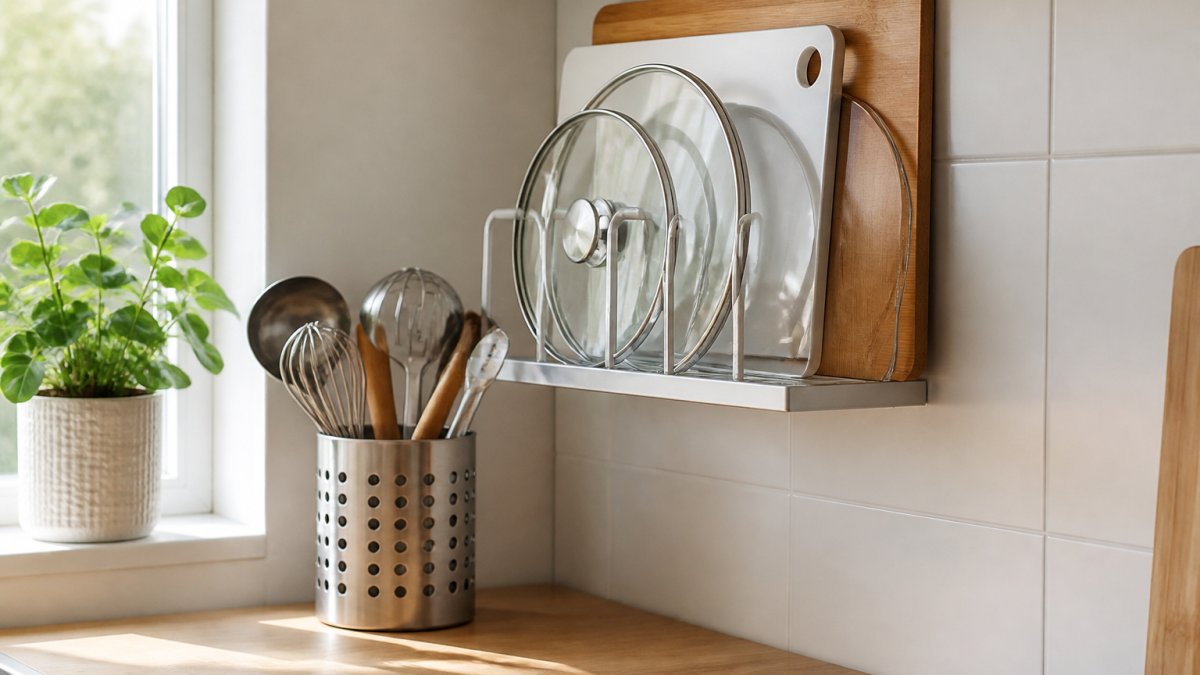
Wall-mounted racks hold pot lids and cutting boards upright so they stop sliding around in cupboards, while a stainless steel utensil holder keeps spatulas, spoons, and tongs together.
Wall-Mounted and No-Drill Options for Renters
Renters need storage that leaves no holes, which matters if you can't drill into tiles.
No-drill options include:
- Adhesive-mounted racks rated for light loads
- Suction-cup organisers for smooth surfaces
- Over-door hooks that clip onto cupboard doors
Our pot lid organiser uses a no-drill setup with adhesive or suction options, holds lids and cutting boards in dedicated slots, and comes in single or double-layer designs. When you move out, it comes with you.

Best Kitchen Organisers for Small Spaces: What Actually Earns Its Place
The best kitchen organisers for small spaces solve a specific problem you already have. Buy for a job, not for a vibe: measure first, understand the material trade-offs, and know which options work in a rental where you cannot drill.
Start with a tape measure and a notebook. Record the internal width, depth, and height of every drawer and cupboard you plan to organise.
Here is how the main organiser types compare on the things that actually matter.
| Organiser | Best For | Where It Goes | Material Trade-Off | Rental-Friendly? |
|---|---|---|---|---|
| Drawer dividers | Cutlery, utensils, gadgets | Inside drawers | Bamboo expands with humidity; plastic is stable but lighter | Yes, no fixing required |
| Tiered shelves | Cans, jars, mugs, spices | Cupboards | Acrylic is easy to clean but can crack under heavy loads; wire is strong but items tip | Yes, freestanding |
| Pot lid rack | Lids, chopping boards | Wall or bench | Adhesive mounts fail on greasy tiles; suction needs smooth, non-porous surfaces | Yes, no-drill options exist |
| Under-sink rack | Sponges, cloths, cleaning bottles | Under the sink | Stainless steel resists rust; coated wire can chip and corrode | Yes, freestanding or tension-fit |
| Utensil holder | Spatulas, spoons, tongs | Bench | Ceramic is heavy and stable; stainless is light and can tip | Yes |
| Over-door hooks | Tea towels, light tools | Cupboard doors | Thin doors may not close with thick hooks; check door thickness | Yes, no fixing required |
Drawer Dividers, Tiered Shelves and Under-Sink Storage
Drawer dividers stop the cutlery drawer from becoming a junk pile. Measure the internal width and depth before you order, because a divider 5 mm too wide will not sit flat and one that is too short will slide around.

Tiered shelves turn a single cupboard shelf into two levels, so you can see the cans at the back.
Multifunctional Kitchen Pot Lid Organizer Rack →
Under-sink storage is trickier because of the pipes. A foldable rack with adjustable feet or a tension-fit design sits level around the plumbing.
The Rental Constraint: What You Can and Cannot Install
If you rent, your organiser choices narrow. Adhesive-mounted racks, suction-cup organisers, over-door hooks, and freestanding tiered shelves are all reversible.
A common pattern among renters is to invest in freestanding and over-door solutions first, then add adhesive-mounted racks only on smooth, clean surfaces. Keep the original packaging so you can take the organiser with you when you move.
How to Decide Without Wasting Money
Ask three questions before buying any organiser:
- What specific problem does this solve? If you cannot name it, do not buy it.
- Does it fit my measured space? Check width, depth, and height against your notes.
- Can I install it without damaging the property? If not, is there a rental-friendly alternative?
Two or three well-chosen organisers solve more problems than a cupboard full of mismatched containers. Buy for the job, not for the photo.
Reclaiming Bench Space: Over-the-Sink and Countertop Strategies
Bench space is the scarcest thing in a small kitchen, so treat every centimetre as precious.
Over-the-sink racks sit across the sink and hold sponges, brushes, and drying items, using space that's otherwise empty above the basin.
On the bench itself, group items by task:
- Keep the kettle and toaster together in one corner
- Put the utensil holder beside the stove
- Leave the middle clear for chopping
A cluttered bench makes a kitchen feel small even when it isn't. Clear the middle and the room breathes.
Making It Stick: Maintenance Habits for a Clutter-Free Kitchen
A clutter-free kitchen stays that way through small habits, not big clean-outs. Habits fail when they are too ambitious or not tied to an existing trigger, so attach each habit to something you already do and make it so small it feels almost trivial.
Habit Stacking: Attach the New to the Old
Habit stacking works because you rely on an existing routine, not motivation, to carry the new behaviour.
- After you finish cooking, before you sit down to eat: wipe the bench and put away the chopping board. This takes under a minute and prevents the post-dinner pile-up.
- While the kettle boils: empty the dish rack or put away dry items. You are standing there anyway.
- When you open the fridge to get milk for your coffee: check for one item that needs using or binning. This keeps the fridge from becoming a science experiment.
The Two-Minute Reset, Explained
The two-minute reset is not about deep cleaning. It is about returning items to their zones so the kitchen is functional for the next meal. Set a timer, put away what belongs in the prep, cook, and clean zones, and stop when it rings. The goal is consistency, not perfection.
One In, One Out: The Rule That Prevents Rebound Clutter
Every time a new gadget, mug, or container enters the kitchen, one item leaves, keeping total volume stable. Apply the rule at the point of purchase: buy a new utensil holder and the old one goes immediately. If you receive a gift you will not use, donate it rather than finding it a temporary home.
The Weekly Five: A Five-Minute Audit
Once a week, remove five items you no longer need: expired spices, a broken spatula, a lidless takeaway container, a mug you never reach for. Five items is small enough not to feel like a chore, but over a year it removes 260 items from your kitchen without a single marathon decluttering session.
Adapting the Habits to Your Household
A household with young children needs different habits from a single professional. Families can make the two-minute reset a game. Renters who move often should keep a "move box" for rarely used items and review it every six months. Batch-cookers should label and date freezer containers as they fill them, not later.
Why Organisation Fails Slowly
Organisation fails slowly: one item left out becomes five, then ten. Catching it early is far easier than fixing it later, which is what the habits above are for. If you miss a day, do not abandon the system. Do the two-minute reset tonight and start again tomorrow.
Conclusion: Small Changes, Noticeably Bigger Kitchen
A small kitchen doesn't need a renovation to feel bigger. It needs a plan, a proper declutter, and storage that uses the space you already have.
At Need Nest, we curate practical home and kitchen essentials designed to make everyday living easier. Our range includes space-saving racks, no-drill organisers, and smart kitchen gadgets, all shipped fast across Australia.
Shop by category at Need Nest and turn your small kitchen into one that works.
Frequently Asked Questions
What are the common mistakes to avoid in small kitchen layouts?
The biggest mistake is buying organisers before decluttering. You end up storing things you never use and running out of room for what matters. Another is ignoring vertical space: wall-mounted racks and tiered shelves free up bench area without adding footprint. Also avoid blocking your main work triangle between sink, stove and fridge with bulky appliances. Finally, don't rely on permanent fixtures if you rent. No-drill options using adhesive or suction keep your bond safe and your setup portable.
What is the best kitchen organiser for a small kitchen?
It depends on where your clutter builds up. If pot lids and cutting boards pile up on the bench, a vertical lid rack with dedicated slots solves that fast. For utensils, a compact stainless steel holder keeps spatulas and spoons within reach without spreading across the counter. Under-sink racks with self-drainage handle sponges and cleaning items hygienically. The right choice is the one that matches your worst bottleneck, not the one with the most compartments.
How do you store pots and pans in a tiny kitchen?
Stack them by size using a vertical rack or a lid organiser that keeps each lid separate. Nest smaller pans inside larger ones, but add a soft cloth between them to prevent scratching. If cupboard depth allows, install a pull-out drawer or a tiered shelf so you can see every pan without digging. Keep the two or three pans you use daily within easy reach and store occasional pieces higher up or in a harder-to-reach spot.
How can I create more bench space in a small kitchen?
Move items off the bench and onto the walls. A wall-mounted rack for lids and boards, plus a compact utensil stand, clears a surprising amount of surface. Use an over-the-sink rack for sponges and wipes so they drain without taking counter room. Foldable sink racks collapse when not in use. Also consider a vacuum sealer to flatten bulky food packaging, which frees both bench and cupboard space for everyday items.